Showing posts with label travel. Show all posts

Monday, September 19, 2011

Part 8c - The Food of Köln

Köln definitely has its own regional character - the accent, words used, the beer, and the food.

Earlier this month, I described our incredibly delicious meal of raw pork, called Hackepeter, in Wollnitz. When we went to Köln, we noticed that people were eating something similar on crusty rolls. I crudely translated part of our food menu at Gaffel and found that they serve something called "Mett" - ground raw pork seasoned with salt & pepper spread onto bread and topped with minced onion.

Sounds gross, right?

It was amazing! The texture was incredible - soft and slightly chewy, much like cured salmon or tuna sashimi. If you're ever in Köln (or the area) and see Mett on the menu, order it. Raw pork sounds pretty awful, but it's quite the opposite. And I'm rather disappointed it's not more popular here.
Mett for lunch at Gaffel

I also noted a couple of other regional specialties. One was "Kaviar", blood sausage with onions & pickles. The other was "Himmel und Äd", which is blood sausage, mashed potatoes, and applesauce. I tried Kaviar and really liked it as well, but preferred the mett.
"Kaviar" with a side salad.  Germans aren't too big on greens.


You can make your own Mett at home. I know, I know, bacteria etc. The key is grinding the meat yourself. NEVER eat raw meat that was already ground when you bought it. If you don't wnat to do this with pork, try it with beef... you'll be making steak tartare, and some great instructions on the process are over on Michael Ruhlman's blog.

Once you've ground/diced the meat (again, see the link to Ruhlman's blog above), dice up some onion (very small dice) and mix it into the meat along with a liberal dose of salt & pepper. You can add some mace, caraway, and/or marjoram if you want, but I don't believe the Mett we had was seasoned with anything other than salt & pepper.

Spread this on a crusty dinner roll or a piece of toast (rye would be excellent for this). Alternately, shape a mound onto a plate, create a little divet in the top, and crack a raw egg onto the top (wash the shell off first), then spread onto toast. I know, sounds disturbing, but it's so delicious. Really, it is.

If you want to try this without making it yourself, bluestem serves wagyu steak tartare on their lounge menu. It's half-price Tues - Fri during happy hour (5-7; 5-6:30 on Fridays), and steak tartare for $6 is a steal.

Sunday, September 18, 2011

Part 8b - The Beer of Köln


Over the course of 2 days, John and I were able to try Kölsch made by 9 different breweries. Each brewery clearly had its on take on the style, but Kölsch definitely has some defining characteristics - and, like Altbier, is served in its own special glass: the 2cl thin-walled Kölner Stange. ("SHTONG-uh".)

Kölsch is a pretty narrowly-defined style, and the following stats come from Eric Warner's book on Kölsch. The BJCP guidelines are even narrower in range. It's a filtered ale typically between 3.5-7 SRM (straw, light gold), has an OG of 1.045 - 1.050, 4.5-5.2% ABV, 16-34 IBUs, and is hopped using only noble hops. It's typically lagered for anywhere from 2-8 weeks (most Köln brewers appear to lager on the shorter end of that timeframe). It should have a soft pale malt flavor character with few fermentation flavor characteristics; it shouldn't be estery, fusely, or fruity. Lagering helps reduce diacetyl & acetaldehyde (green apple) as well.

Similar to Düsseldorf & Bamberg, the beers are often served from cask. The glasses are carried around by the servers in a tray called a Kölschkranz. The tray holds several beers at a time, and in at least a few places, the beers are filled halfway and set aside until someone orders them. The glasses are then filled to the brim and carried out. Unusual and seemingly inefficient, but fun to watch.

Another note about serving is that the person serving Kölsch (called a "Köbes") wears a long blue apron - and is typically male. While we did get our Kölsch poured by a female at one brewhaus (Reissdorf), she wasn't a Köbes. While it's not against the law to hire a female Köbes, it appears that it's just not done.

Kölschkranz at Gaffel

Filling the Stanges. You can sort of see the cable mechanism in the background that Sion uses to bring the casks up from the cellar. 

Gaffel am Dom
This was the first Kölsch we had, and it ended up being one of my favorites. It had a lot of sulphur in the nose and was a bit vineous as well. I loved the contrast of the soft pils malt with the prominent (but not dominating) hop bitterness. The sulphur was also detectable in the flavor, but it was slight. I was surprised at this, as I'd have thought sulphur would have been undesirable in Kölsch but it was a rather common characteristic. Regarding the brewery itself, it's right on the cathedral square and the first recorded mention of it is dated 1302. Sadly, it was completely destroyed in WWII but (thankfully) rebuilt in 1955.

You can find Gaffel in some parts of the country; I tend to see it on the east coast. I definitely recommend ordering a glass if you ever see it on tap.

Früh
To contrast with Gaffel, Früh's Kölsch was a lot of sweet pils malt flavor, fruity esters, and had low hop bitterness. I got a lot of apple, pear, and white wine in both the aroma and flavor; it almost seemed like watered-down apple cider. The body was light, and the finish was very dry. While I didn't enjoy this Kölsch as much as Gaffel's, it'd be perfect on a hot summer day. I don't believe you can get this in the US.

Früh was founded in 1904 and made a less-bitter ale than the other breweries at the time. Remember that leading up to the early 20th century, the popular beer at the time (wiess) was bitter and unfiltered. It's suggested that Früh led the transition to the form of Kölsch we know today, though there isn't a lot of information I could find to back that up.

Brauhaus Sion
Similar in age to Gaffel, Sion was founded in 1318 but survived through the world wars intact. Their Kölsch had more of an earthy, herbal hop aroma than the others; the hop flavor was a bit different as well, being a bit peppery (but not spicy). Sion's Kölsch was low in sulphur and a bit "tangy" but low in acidity. Some Kölsch brewers use a little wheat in the grist, and Sion is one of them.


Peter's Brauhaus
Peter's is an interesting brewery, as they brew a pretty broad variety of beer. Though 95% of what they brew is Kölsch, they also make Altbier, pilsner, festbier, and a weizen. We didn't have any of those, though, and I'm not even sure they serve them at the brewhouse. We went to Peter's twice on our trip and had two entirely different experiences. The first night was subdued and laid back; the second time around, we were crammed into this little tasting room that seemed to keep getting more & more crowded. I remember crawling over a table just to get out.

I really enjoyed the beer (less so the 2nd time around, but only because I'd tried more Kölsch by that time and preferred others more). It had a mild floral hop aroma and had a bit more hop bitterness than some of the other Kölsches we had but still retained a solid malt/hop balance.

Malzmühle
In the 13th - 15th centuries, brewers made their own malt and would sell excess malt in the city center for regional breweries and homebrewers. The brewery located at that malt market is creatively named Malzmühle (malt mill), and we stopped in for a tipple.

Like the others, Malzmühle's Kölsch was a bit sulphury but also had a touch of green apple - likely from acetaldehyde. The pils malt sweetness was a bit dominant in this one and the hop bitterness was restrained. The finish wasn't quite as refreshing or dry as I'd hoped and I left this brewery unimpressed.

Päffgen
We were near a now-defunct brewery (zur Täsch) that serves as a beer bar, so we stopped in to try some Päffgen Kölsch (I'm getting a little tired of all the umlauts now). This place was a trip, as the decor inside all seemed to be from Gothic cathedrals.

Later on in our trip, we went to the actual Päffgen brewhaus and enjoyed it even more. The brewhaus is gigantic and full of different rooms. We went in late afternoon and the place was already packed

I really enjoyed Päffgen, though, and wish we could get it in the US. The lightly-sweet pale malt character shone through, but was met with a reasonable amount of hop bitterness and floral flavor & aroma. It was a perfect combination of tartness, malt sweetness, noble hop bitterness, aroma, & flavor, and a touch of sulphur in the nose. This quickly became one of my favorite beers of the trip...

Dom Kölsch
... and then we went to Dom.

Light sulphury aroma met by noble hops and faint pils malt breadiness. Flavor wasn't malty-sweet at all (finally!) and the finish was actually reasonably bitter and dry. It had a little bit of malt sweetness at the end, but really the balance was toward the bitterness of the hops used.

We ended up coming here twice and enjoyed the beer just as much both times. This became the most-liked Kölsch for both of us. And despite Dom being one of the largest Kölsch brewers in the country, their beer is, unfortunately, not available in the US.


Reissdorf
But one Kölsch that is available in the US is Reissdorf! (Pronounced "RICE-dorf") When you think of Kölsch, this is possibly the brand that comes to mind. And while it wasn't our most favorite we had on our trip, it was still quite delicious, and fun to drink at the brewhaus.

Like Gaffel, the Reissdorf brewery was obliterated during WWII. It was rebuilt and brewing again by 1948, making several beers in addition to the Kölsch (such as pilsner & a dark lager).

I thought the aroma of Reissdorf's Kölsch was fantastic. Just a touch of sulphur, but in the forefront were the pils malt & floral hops... and unripe pear. I am not a fan of the fruitier Kölsches, and this was one of them. While the fruitiness & sweetness were not overwhelming in the least, they just led me to enjoy the Kölsch a bit less than those that had a sharper character to them (more hop aroma & bitterness, more sulphur).

That said, as I've been writing about Köln, I've been craving some Kölsch - and Reissdorf is available here in KC. You can get it on tap at Flying Saucer & Grünauer - and if you ask nicely at Grünauer's Wunderbar, they'll even serve it to you in a glass that's similar to a Stange. (I asked if they served Kölsch in a Stange, thinking they'd laugh at me, and instead I got my beer in a cylindrical glass! I love those guys!) Of course, you can get Schlafly's excellent Kölsch-style ale, but if you want a Kölsch from Köln, Reissdorf's is probably the most accessible.

Sünner
For our last dinner in Köln, we had mussels at a place called Bier Esel, which is apparently famous for them; they also serve Sünner Kölsch, which we hadn't yet tried. The Sünner brewery was destroyed in WWII, but like others, was rebuilt and brewing again. I found their Kölsch to be a bit too sweet, however, and didn't care too much for it. The hop aroma & bitterness were quite subdued, and instead the balance was toward pils malt & a moderate amount of apple-like fruitiness. Not my favorite.

The Verdict
I had a wonderful time trying all these variations on Kölsch. We tried beers from nine Kölsch breweries, a little more than a third of the number of breweries allowed by the Konvention to call their beer Kölsch. And here is how we ranked them. Both John and I came up with our individual lists and as it turns out (perhaps not surprisingly), that we ranked them in the same hierarchy.

  1. Dom
  2. Gaffel
  3. Päffgen
  4. Peter's
  5. Sion
  6. Reissdorf
  7. Sünner
  8. Malzmühle
  9. Früh

Next up - the food of Köln.

Wednesday, September 14, 2011

Part 8a - Köln & the history of Kölsch


After our day in Düsseldorf, we drove half an hour to what would turn out to be my second-favorite city on the trip, right after Prague. Köln was beautiful and the architecture interesting.  And the brewing history there is just about as fascinating. Probably most notable is that the Köln brewers have organized in various forms for over 700 years as a way to protect their industry from governmental interference, black-market brewers (those damn homebrewers!), and external competition.

Kölsch wasn't a style until recently; it's a relatively new style whose form as we know it today is less than 100 years old. It wasn't even a prominent style in the city until after WWII. Its predecessors, though, have an interesting history. Gruit (beer bittered with herbs) was the prominent style in Köln up through the 1400s. A heavier, maltier beer bittered with hops called "keutebier" from the north started gaining popularity around that time, but the Köln breweries disallowed production of this style as a way to protect their products. At the same time, taxation on beer was based on the strength of the beer and new taxes on hops were introduced; this heavy taxation solidified Köln brewery resistance against brewing keutebier. In 1495, however, brewing gruit became illegal and breweries turned to making a lighter version of the popular keutebier to stay in business while avoiding high taxation.
Köln cathedral at night

In the 1800s, when the indirect heated kiln was invented and maltsters were able to kiln malt at high temperatures without heavily roasting or smoking the grains, brewers started making a pale, hoppy, unfiltered pale ale called "wiess" ("veess"... rhymes with "fleece"). Filtered, they called it Kölsch. And a style was born.

Fast forward through French occupation and their dissolution of the brewers' guilds, two world wars, the destruction of several of Köln's breweries, commercial competition, the loss of most of the city's brewers, quickly-expanding love for Pilsners across Germany and Europe, and you have a pretty big threat to Köln's identifying brew. Rebuilding Köln's brewing culture took a few decades, but included the emergence of the Association of Köln Breweries and the Köln Brewers Corporation. In 1986, the Kölsch Konvention declared Kölsch the official beer of Köln and protected it under an appellation. That's why you'll often see "Kölsch-style ale" (rather than "Kölsch") on beer made outside the Köln area.

So with its origins in gruit, keutebier, and unfiltered wiess, we now have Kölsch. We'll get into its modern incarnation next, and I haven't really done the style justice, but I find its history interesting. If you want to find out more, check out Eric Warner's book on the style.

And next... on to the beer itself and some of the breweries that make it.

Monday, September 12, 2011

Part 7: Düsseldorf

I was going to write about Düsseldorf and Köln in one post, but there's so much to say about each of them, that I've decided to split them into two separate posts. Düsseldorf is home to Altbier, a German ale that's typically known to be fairly nutty & moderately bitter. Our time in the city of Alt, though, proved to us that Altbier is a widely-variable German ale that ranges from nutty & bitter to moderately malty-sweet & floral. If you think about the amount of variation in American Pale Ales, or even IPAs, you get a comparable amount of variation in German Altbier.

Cask at Schumacher
One of the images I remember most from this trip are the casks in various bars. Bamberg's breweries used them, as did those in Düsseldorf (and Köln, which is up next). Some people have this bizarre notion that German beer is served warm; I suspect that comes from the fact that it's not served at "Coldest Beer in Town!" temperatures. Despite that, it's still served plenty cold, but more like cellar temperatures (low 50s). Perfect for being able to smell and taste your beer.

There are several Altbier breweries in Düsseldorf , and we did our best to check out the most notable. Here's a run-down of where we went & what we thought:

Brauerei Schumacher
Very clear, light brown/amber in color. The aroma was sweet, nutty, toasted malt with a bit of doughiness and a floral hop aroma toward the end. The flavor was prominently toasted nuts and bread, with a bit of a floral hop flavor but lingering bitterness in the finish. I was really surprised at how bitter this beer was; it was one of the bitterest beers I'd had on the trip, but the malt character balanced it out some. Even still, this was - surprisingly so - quite a bitter beer.

Zum Schwartze Maus
We walked about 4 miles from Schumacher to Schalander, only to find out that Schalander was closed. So, we found this place across the street that served a couple of different alts. I tried the Frankenheim Alt which, as you can probably tell from their website, is a bit... commercial. It was pretty sweet and presented brown sugar & caramel right away. It almost had a sweet "Ricola" type of malt character that gave way to a toasted almond presence. The hop bitterness was subdued and certainly not in balance with the malt. I wasn't impressed.

Hausbrauerei zum Schlüssel
After a convoluted tram ride from the black mouse pub, we stopped in zum Schlüssel to rest our feet and revive. As you can see in the picture, alt is served in the little cylindrical glasses; they're all about .2 or .25cl. I love this, because I so often want smaller servings of beer, just so that I can taste different beers. But when the place offers one beer, it's kind of an annoyance... but anyway...

This one ended up being one of my favorites. It was very nutty, likely from the Munich malt, and quite bitter - but not as bitter as the alt at Schumacher. It had some spicy hop notes at the finish, adding to the complexity. I really enjoyed this beer; it had a fantastic balance of malt sweetness & toast, hop aroma & flavor, and bitterness in the finish. I'd love to have this available in the US.

In the picture, you can also see the small gray crock in the background. Every single bar & restaurant in Düsseldorf we went to had these on the table. One would hold flatware, another held mustard. I should have bought some of my own. You can't have enough mustard.

Zum Uerige
This place was insane. You probably recognize the name, and it was largely a tourist attraction. However, it was clear they work hard not to turn it into the ridiculousness in places like U Fleků. And, as it turns, out, they had my favorite Altbier of all the alts we tried.  The malt character was a bit more complex than the others we had. While it definitely had the toasty Munich malt notes, it must have also had a decent amount of crystal malt in it, lending a bit of caramelly sweetness. You got that initially, but each sip ended with a spicy - and slightly funky - hop flavor with moderately high bitterness.
They keep track of how much you drink by marking your coaster.
Is this because the glasses are so bitsy?

We're coming up to Sticke release time (every October & January), so we should start seeing fresh bottles on shelves of our liquor stores here in KC in the coming months. I'm quite curious about their distilled Stickum (moreso, Stickum PLUS), but haven't seen it here... if you have, let me know where you spotted it.

Funny story about this place; their servers are notorious for being a bit impish. I went to the restroom during our visit, and on the way back to our table, our server fake-punched me in the stomach. German flirting at its finest? Not sure, but it did make me laugh just because it was so off-the-wall. Wacky Germans...

Im Füchschen
This place was a short walk from Zum Uerige, so we stopped in for a small beer (remember, these are 20cl pours of 4.5% ABV beer, which is slightly weaker than 6oz of Boulevard Wheat at a time). Their beer was super-nutty with a scant amount of floral hops. There wasn't much bitterness in the finish at all, which made it very drinkable but also relatively uninteresting. We had one beer and left, but not before noticing that their food menu featured steak from Nebraska.


Overall, here is how I rated the alts we tried, from best to ... not best:
1) Zum Uerige
2) Hausbrauerei zum Schlüssel
3) Schumacher
4) Im Füchschen
5) Frankenheim

It's a good thing, then, that we can get what I thought was the best one here in KC. Granted, it's almost impossible to find the original altbier, but the Sticke is fairly available, and we do get it seasonally.

I told you I had a lot to say. :)

Saturday, September 10, 2011

Part 6: Dortmund

After we left Wöllnitz, we drove across the German countryside to the Dortmund/Düsseldorf/Köln area, stopping in Dortmund for a night's stay before a couple of days in Köln. Dortmund was cute, but nothing too remarkable or notable. We went to the city center for dinner and ended up in "Zum Alten Markt" ("at the old market") that was like a German version of Old Spaghetti Factory. Kitsch everywhere, gigantic portions of mediocre food, and slow service. Its saving grace was the beer, but even then I didn't mind leaving.
Bird cages hanging from the ceiling of Zum Alten Markt.
It was just missing the streetcar in the middle of the restaurant.

We crossed the square to a place called Brinkhoff's and enjoyed a house beer (eh) and a delicious Czech black lager called Krusovice Cerne. Like others we tried in Prague, this one smelled and tasted a bit of plums and dried fruit, but was still light-bodied and easy to drink. There was a touch of roast & coffee in the finish thanks to the dark malt. There aren't a ton of black Czech lagers you can get here, but Bernard Cerne is fantastic - and easily available in KC (at least at Royal, anyway).

Pilsners in this area come in stemmed glasses - not what we know as pilsner glasses - with paper doilies.
I could have sworn I'd read that you could get Dortmunder Export at Zum Alten Markt, but apparently I remembered wrong. Your best bet at getting a Dortmunder Export in the US is going to be via Ayinger's "Jahrhundert" beer, or Great Lakes' Dortmunder Gold (for which you'll have to trade or travel).

Bottom Line - the best beer I had in Dortmund was a Czech beer. I'm sure others have different experiences, but I found most of the local pilsners to be flabby and unremarkable. Pilsner malt graininess, mild hop bitterness, floral hop aroma, and light residual sweetness; nothing outstanding but nothing horrible. Not that I was ungrateful to be there; it just paled in comparison to the other cities we went to. But, the mediocrity was short-lived, as the next day we headed off to Düsseldorf and Köln for some Altbier and Kölsch .

Friday, September 9, 2011

Part 5: Wöllnitz

I haven't written about our Germany trip in months, and I'm determined to finish this bad boy. Let's do this.

After our evening in Leipzig at the Ohne Bedenken, we trekked out to find packing material for transporting our beers. The plan was to buy a box, tape, lots of bubble wrap & packing peanuts, and check the box as luggage. After a lot of searching in a big mall, we finally found a box, but no packing materials. Batting and fake-snow fluffy stuff from the Christmas decoration section would have to do. We also found some cheap-ass cherry mead (3 for a 750ml bottle - and it was actually pretty good!) and entertained ourselves with the flat escalators in the mall.
Despite the best engineering intentions, shopping carts are difficult to hold in place on these things.

With our purchases in tow, we headed toward Wöllnitz, which John had read about on Ron Pattinson's blog. Incidentally, on the way to Germany, we also read Stan Hieronymous' "Brewing with Wheat" where he  mentions this city's unique style of beer. Gasthausbrauerei Talschänke brews a sour wheat beer there, called Wöllnitzer Weißbier. Beer Advocate & Rate Beer list this as a Berliner Weisse, but it's actually a derivative of an old style called Lichtenhainer - a sour wheat beer made partially with smoked malt.
Smoky sour wheat beer in Germany

The aroma was bready and very citrusy, like a lemon sherbet, with a very faint floral hop aroma at the finish.  The flavor was also citrusy, but not so much as the aroma was. The finish was smoky and bready; the wheat in the grist contributed to a light graininess that complemented the citrus character well. We both thoroughly enjoyed it, but I have to admit...

... I liked the Jever better. A very bitter German pils, Jever on tap is something to behold. You can get something sort of close to Jever at Grünauer by ordering a glass of Czechvar, but it won't be nearly as bitter or delicious.

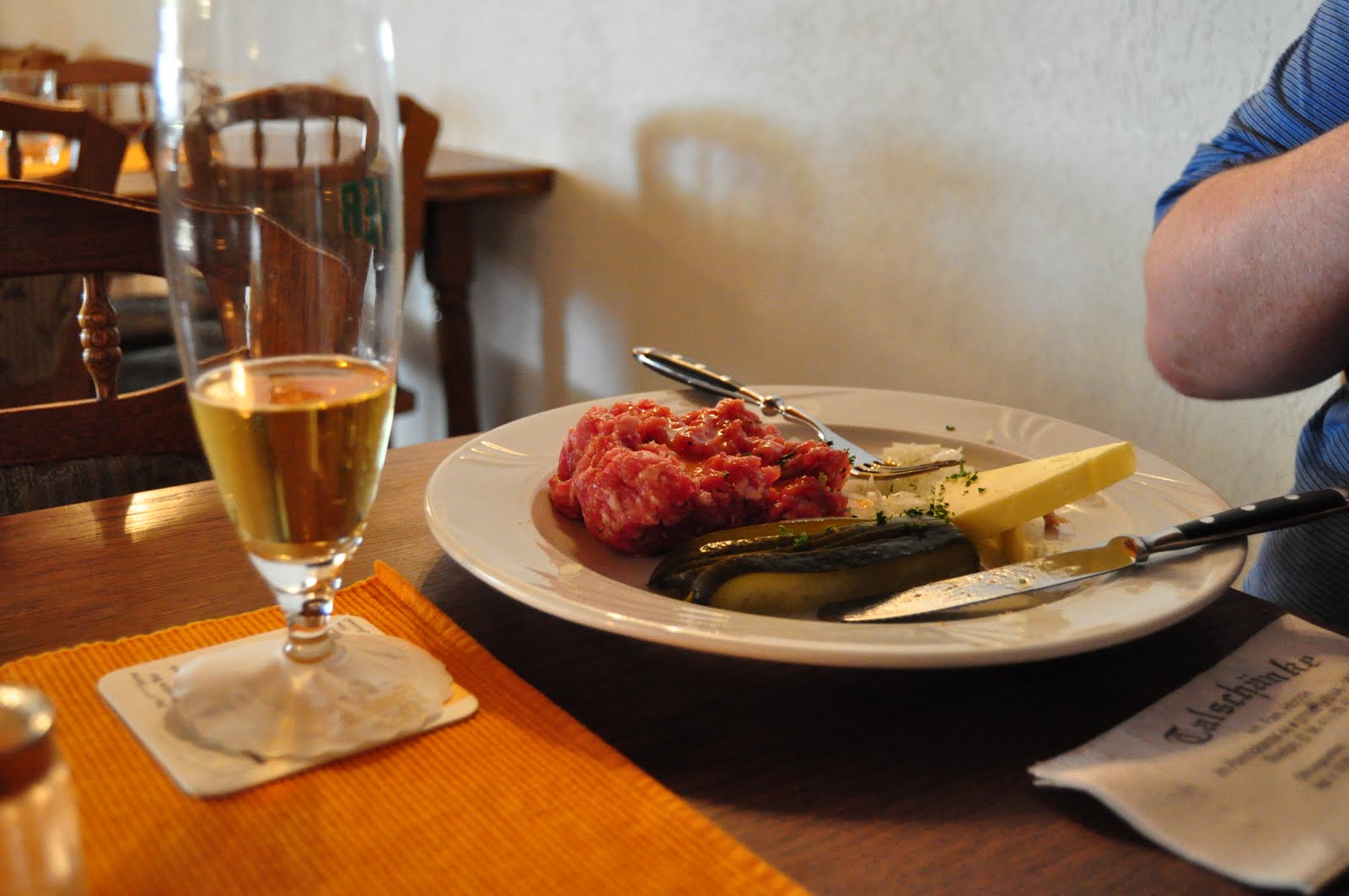
And speaking of delicous? Hackepeter! Take raw pork, add some fresh onion, a raw egg and some spices, toss it on a plate, and voila - deliciousness on a plate. My mother would die knowing we were dining on a plate of raw pork & raw egg, but I am starting to believe that cooking meat ruins it.

A bit of Jever next to some Hackepeter, a pickle, and a giant wedge of butter
It's a regional specialty, and we ran into a variant of the raw pork delicacy in other cities... but first? Dortmund.

Wednesday, July 20, 2011

Engine & Cask

We took a trip to Chicago earlier this year for a homebrewing competition as well as a long weekend getaway. Among some of the typical places we wanted to hit (Map Room, Publican, Goose Island Clybourn), we had our sights set on Owen & Engine. We wouldn't have known about this place had it not been for Elliot (from Waldo Pizza) moving to Chicago and getting a gig there as the Beer Manager. We ran into him last fall and he mentioned the place to us. We couldn't wait to check it out.


Owen & Engine
Photo from Metromix Chicago
There were several reasons we wanted to go (one of them being the stellar British-inspired food menu), but the main one was for the beer engines. They've got four of them set up behind the bar, each with carefully-selected beers available. The place also has 20 separate taps at the bar, again all thoughtful and representing a wide variety - everything from Rodenbach Grand Cru to Bitburger, cider, and Cafe Negro. We had a great time trying a bunch of the beers on engine, as well as those on the standard taps and I recommend stopping here any time you're in Chicago.


I'd really like to see more places in Kansas City offer beer on engine (whether cask or keg), or even gravity-fed from a cask. A few bars around town do have engines, but they’re rarely ever in use. And while beer on engine can be kegged with CO2 gas maintained at a low level to keep a blanket over the beer, it’s the beer in a cask that is really something unique (ever try an IIPA on cask? Amazing difference between its kegged counterpart!). But its shelf life is short, and the last time I did have something from cask here in town, it had oxidized beyond salvation. It seems we just don’t have enough interest in beer on engine and/or cask to really make it worth the bar’s time or expense.

However, it looks like St Louis is experiencing a surge of attention to cask beer. iTap introduced its cask program this spring:  they purchased empty casks and now send them off to various breweries to be filled and returned. And STLhops.com just announced that Lohr Distributing recently purchased casks for a similar program catering to multiple bars in the STL area.

If the KC beer scene keeps moving forward as it has in the past 2-3 years, it’s only a matter of time before we start seeing a revival of cask nights and dusting off the ol’ beer engines. I hope.

Sunday, March 6, 2011

Part 4: Leipzig

It was a several-hour drive to Leipzig, quite possibly because there was major freeway construction going on that led us to follow detour signs which disappeared after about 20 minutes of driving down country roads. (you try reading construction signs in Czech!) We had a GPS unit, but it kept trying to take us back to the (completely closed) freeway. So, we decided to follow the car in front of us since it had been following all the detour signs … that was working so well (for about 45 minutes!), until it stopped for gas. Thankfully, we started seeing road signs for Dresden, so I knew we had to be getting close.

For reference, here's a map showing our trip to this point (Frankfurt, Bamberg, Plzen, Prague) and through to Leipzig:

We arrived in Leipzig just in time for lunch, but stopped to check in at our hotel and drop off our stuff and the car. Then – Gose time! The only other time I’d had Gose was when I picked up a small bottle of Bayerischer Bahnhof Gose at Lukas Liquor. And there we were in Leipzig, just a few miles away from the Bahnhof itself.

The brewery is one of the only Gose breweries in the world (yes, I know many US craft breweries make Gose, but that’s far from their specialty) and is housed in the old main train station that served eastern Germany and Bavaria, and on south through Italy – hence, Bayerischer Bahnhof (Bavarian train station).

Gose is an old German style that was originally brewed in Goslar but has since been adopted by Leipzig. It nearly became extinct after WWII as a result of brewery nationalization, but experienced a revival in the 50s, near-extinction in the 60s, and second revival in the 80s. Despite its roller-coaster history, the style is likely to stick around for a while now that US craft breweries have picked it up.

The style is traditionally packaged in bottles that are round at the base with a long, slim neck at the top, which we don't really see here in the states (although I did see one at a natural foods shop in Jacksonville). Since Gose's traditionally bottle-conditioned, yeast from the secondary fermentation would rise up in the neck and create a yeast plug. I suppose breweries saved on bottle capping equipment that way...

Traditional Gose bottle
Of course, we started with glasses of straight Gose (so hardcore, I know). It had a prominent citrusy lemon flavor with a tart finish from lactic acid that was only lightly puckering. The lemon paired well with the pils malt grainy flavor and the softness of the wheat. It had medium-high carbonation with medium body & fullness, but the acidity kept it light & refreshing. Absolutely delicious, and perfect after our three-and-a-half mile walk.

Gose, served in its traditional footed glass
Gose is brewed with salt and coriander, but it’s not salty and the coriander is much more subtle than that of a wit. The tartness is quite refreshing, and makes the beer all too easy to drink. That being said, it is commonly served with a shot of syrup in it, much like Berliner Weisse. After having it “pur”, I naïvely ordered a glass with a shot of woodruff. Think liquid Ricola. With a straw.

Bad idea
Because I apparently don't learn a lesson very well, I also ordered a "Regenschirm" (umbrella), which is Gose with a shot of Kümmel (caraway) liqueur - also a regional specialty. Not that it was bad, but the delicate nature of the Gose is completely overwhelmed by any additives. I suppose that’s the point if you’re not a fan of the sour nature of the beer (but then, why drink it?).

Cue more walking. Mildly buzzed and enjoying the sights, we noticed a small wine & liquor store that specialized in scotch. Figuring we’d check it out, we walked in & talked to the proprietor for a little while – and walked out with a bottle of the only Bavarian whisky he had. Note to readers:  Germans don’t make great whisky.

Just around the corner from our hotel (yes, this was intentional) was the famous Ohne Bedenken. This is the destination for Gose in Germany – and, most probably, the world. The owner has worked for decades to promote Leipzig’s distinctive sour beer, and he’s done quite well.  The place was quaint and we settled in to a table off to the side of the restaurant with a couple half-liters of Bahnhof Gose.

Gose = happy
Gorby (and a small pic of Putin on the right)
The owner came by and commented on us drinking it without syrup - "so sour", he said, but followed that with a comment that he gets a lot of Americans coming in & drinking it that way. This guy was a trip. He was highly charismatic and chatty, and very enthusiastic about the history of the pub and Gose. There were pictures of Putin and Gorbachev inside the pub, and the owner made a point to tell us about how Putin would bring his officers there to drink Gose between 1986-88 and 1991-93.

After our Bahnhofs, we ordered Döllnitzer Ritterguts Gose and were nearly knocked out of our chairs. It was darker than the Bahnhof version and much more sour & lemony with less wheat character.  The mouthfeel was a bit lighter and we both enjoyed this quite a bit more than the Bahnhof one. We ended up buying several bottles to bring back to the states with us to share with others.

Owner of the Ohne Bedenkend
You can get some of the Bahnhof Gose around the KC area; Royal carries it, as does Lukas in Martin City. The bottles are small & on the bottom shelf, so you have to actively look for it. I haven't seen it on the KS side, but if you have please note such in the comments. The Döllnitzer Gose isn't distributed in the states as far as I can tell.

For more information on the style of Gose and its history, check out these posts/articles:

Tuesday, March 1, 2011

Part 3: Prague

At this rate, I'll have all my Germany thoughts done around the same time we leave for another vacation… I left off with us checking out a brewing museum in Kulmbach, heading east across the German border into the Czech Republic. I was getting low on gas but figured it'd be cheaper in the former eastern bloc and held out until we were out of Germany. Much to my surprise, gas was actually significantly more expensive. Instead of being about €1.30 per liter, it was €1.75. That's per liter, not gallon.


Another interesting note about crossing the border was the absolute lack of any formality in doing so. We simply drove across country lines – no checkpoints, no passport review, not even a sign stating "Welcome to the Czech Republic!" The only way to tell we were in another country was a sudden inability to pronounce the road signs.


We stopped in Plzen on our way in to get some lunch. Unfortunately, it was Sunday so most everything was closed. We tried to go to the Bernardus Inn, which features a bunch of Bernard beers. You can get a couple of those here in KC, notably the amber and dark lagers, and I recommend doing so (more on that in another post). They're not what you typically think of when someone says "Czech lager" and they're very good - balanced malt, light roast, and moderate noble hop bitterness.

Almost forgot to take
a picture!
We ate lunch at the Na Spilce restaurant on the grounds of the Pilsner Urquell brewery, starting off with the namesake, of course. I ordered head cheese & bread for lunch, and John got a flat sausage that was coated in red pepper & rolled up into sausage form. It wasn't pretty, but it sure tasted awesome. But as for the beer - it was bready, yeasty, almost slightly fruity in aroma. There was quite a bit of sulphur in the nose, indicating it wasn't lagered too awfully long before serving. The finish was balanced, with lingering hop bitterness and bready pils malt sweetness. I absolutely enjoyed it and wish we could get it that fresh here. Czechvar is a pretty good substitute, however (often on tap at Swagger, and usually available at Grunauer). We ordered a couple more beers and headed on our way to Prague.


Master 18, a sweet dark lager - essentially a Baltic Porter. Very caramelly with some dark chocolate bitterness. Heavy on the dried fruit (raisin, prune) with a sweet finish.

John's Dunkel


U Fleků
It took us another solid hour, plus a couple turns of swearing at the GPS unit, to get to our hotel in central Prague. Once we got there, we stashed our car in the parking lot for the duration of our stay and walked over to the famous U Fleků, which was founded in 1499. It's a big tourist attraction and, as a result, was very crowded; it took us a while to get a spot at a bench table. Unfortunately, it was so damn smoky in the place, we couldn't really enjoy or appreciate the beer. You could have told me it was a smoked dark lager and I would have believed you. There was enough sulphur in the aroma to get past the smoke, though, and also reminded me of a chocolate coffee candy. It actually had moderate body, something I wasn't expecting from what I figured would be a light, refreshing, but lightly roasty lager. We left after our one beer, though, narrowly escaping our demise by smoke suffocation. Interesting place, with a ton of history and opportunities for people-watching, but you can do that elsewhere in Prague without needing an oxygen tank. Yes, it really was that smoky.


U Fleků's dark lager, "Flekovsky Tmavy Lezák 13°"


Sampler tray at Pivovarsky Dum
After a bit of walking around and playing tourist, we headed over to Pivovarsky Dum, a brewery restaurant that makes a ton of different beers (not at all common), including a "beer champagne", aperitif, and even a Russian Imperial Stout! We both got samplers and took a bunch of notes. The sampler included the following beers: Light, Dark, Wheat, Saison, Banana, Sour Cherry, Nettle, and Coffee. My favorites were the dark lager & sour cherry, but the nettle was probably the most interesting. It was quite savory and reminded me of some sort of baked dish, like lasagna. The nettle added a good amount of bitterness, but made me feel like I was drinking wheatgrass. Points for novelty.

Nettle beer

And now, some non-beer pictures of Prague.

"Dancing House" based on a design by
Frank Gehry and Vlado Milunic

Charles Bridge. And a lot of tourists.

St Vitus Cathedral at the Prague Castle

View of Prague from the top of the cathedral. It was unfortunately
hazy for all of our stay in Prague.

One of the cathedral spires
I don't know, either. 

Sunday, November 21, 2010

Finding Treasure in Tulsa & Springfield

A homebrew competition in Tulsa set us out on the road again this weekend. The Fellowship of Oklahoma Ale Makers (FOAM) held their 19th annual homebrew competition at Marshall Brewing Company, Tulsa's first production brewery since before WWII. The master brewer, Eric Marshall, studied in Germany for a couple of years and worked at Victory Brewing before returning home to Tulsa to open up shop.

Tanks @ Marshall Brewing
And his experience shows. They had a Best Bitter, a Robust Porter, an American Wheat with orange peel and coriander, and an India Black Ale on tap there at the brewery for us to sample. All four were fantastic, but the porter & black ale really stood out. The black ale is the first in their "El Cucuy" series and is a great take on this recently-popular style, with notable roasted malt character and both floral & citrus American hop flavor & aroma. Delicious and hard to resist.

Unfortunately, you won't find their brews in KS or MO since they don't yet distribute outside Oklahoma. However, they're working on changing that; keep your eye out for these guys.

In the meantime, if you find yourself in Tulsa, their beers are on tap all over town. We had a bad experience with the bitter & IPA on beer engine at McNellie's, but that shouldn't stop you from ordering a Marshall beer on tap. Or from buying it in the bottle.

As a side note, OK has one of the stranger liquor laws I've come across. Like KS, grocery stores cannot sell beer over 3.2% ABW. Liquor stores can, of course, sell beer over 3.2% ABW - but this is where it gets weird: it must be sold at room temperature. So much for proper storage of IPAs.

Public photo from TripAdvisor
On our way home, we took a detour to Springfield, MO for a visit to Springfield Brewing Company. It wasn't too far out of the way, and its master brewer is Ashton Lewis - also known as Mr Wizard to BYO readers. We each got a sampler, which contained an American Wheat, German Helles, Marzen (their seasonal), Pale ale, Stout (their black sheep offering), and IPA.

Sampler Tray at Springfield Brewing Co
All were enjoyable, but the Wheat & Helles (which they simply called "lager") really stood out. The wheat was hoppier than is typical with American wheats around here, and Mr Wort Hog suspected it was lagered due to a light sulphuric aroma. You'd be missing out on a great American Wheat if you passed this one up.

Tuesday, November 16, 2010

Part 2: Kulmbach


Since we had three full days in Bamberg, we decided to take a day trip to Kulmbach, which is about 45 minutes north of Bamberg. We went primarily for the Beer & Bread museum, which is also adjacent to the Mönchshof brewery & biergarten. The Mönchshof line was originally brewed by the Mönchshof-Bräu brewery until the early 80s, when it was bought by Kulmbacher Brauerei (who also owns the EKU brand).  We get their Schwarzbier here in the states, and I was anxious to try it fresh off the tap to see how it compared to our boat-aged bottled version we get here.

The beer museum was definitely worth visiting. The bread museum wasn’t really that interesting and, as a result, was completely empty save for a couple of unknowing American tourists. We probably spent a good 1-2 hours in the beer museum, though, marveling over all the old brewing and bottling equipment. 


Old bottling system

Cool ship

The museum brews its own beer (and bakes its own bread), using open fermentation tanks. At the end of the tour, you get “Museumbier” and some museum bread to accompany it.
Open fermentation at the museum


Museum bread in solid & liquid states

After our educational lessons on brewing & baking, we settled in to the beer garden for a midday brew. There was a live band playing on one side of the biergarten, entertaining a few dozen Germans there for the afternoon. In typical fest form, they all had interlocked arms and were swaying back & forth while singing along to some traditional drinking songs.

While taking in the sights & sounds, I thoroughly enjoyed my much-anticipated Mönchshof Schwarzbier. This style can be deceptive due to its appearance; it's not rich or creamy, it doesn’t have sharp roastiness, and - as with other German lagers - you won't find fruity esters from the yeast. The version from Mönchshof was lightly roasty, only mildly sweet, and wonderfully dry. It had just enough hop bittering to balance the roast and malt, with a faint hop aroma or flavor (too much would have been unwelcome). Perfect for a beautiful fall day.

The difference between having this beer on tap in Germany vs. from a bottle (or even a mini-keg) in the US was noticeable, but not dramatic. You can find their Schwarzbier in a lot of stores that carry a broad selection of imports.

Or, you can try a similar but more fresh & vibrant version on tap at Gordon Biersch. Put some traditional German drinking songs on your MP3 player, don your headphones, and pretend you're in Northern Bavaria. Eins, zwei, zuffa!

ShareThis