Showing posts with label german beer. Show all posts

Sunday, September 18, 2011

Part 8b - The Beer of Köln


Over the course of 2 days, John and I were able to try Kölsch made by 9 different breweries. Each brewery clearly had its on take on the style, but Kölsch definitely has some defining characteristics - and, like Altbier, is served in its own special glass: the 2cl thin-walled Kölner Stange. ("SHTONG-uh".)

Kölsch is a pretty narrowly-defined style, and the following stats come from Eric Warner's book on Kölsch. The BJCP guidelines are even narrower in range. It's a filtered ale typically between 3.5-7 SRM (straw, light gold), has an OG of 1.045 - 1.050, 4.5-5.2% ABV, 16-34 IBUs, and is hopped using only noble hops. It's typically lagered for anywhere from 2-8 weeks (most Köln brewers appear to lager on the shorter end of that timeframe). It should have a soft pale malt flavor character with few fermentation flavor characteristics; it shouldn't be estery, fusely, or fruity. Lagering helps reduce diacetyl & acetaldehyde (green apple) as well.

Similar to Düsseldorf & Bamberg, the beers are often served from cask. The glasses are carried around by the servers in a tray called a Kölschkranz. The tray holds several beers at a time, and in at least a few places, the beers are filled halfway and set aside until someone orders them. The glasses are then filled to the brim and carried out. Unusual and seemingly inefficient, but fun to watch.

Another note about serving is that the person serving Kölsch (called a "Köbes") wears a long blue apron - and is typically male. While we did get our Kölsch poured by a female at one brewhaus (Reissdorf), she wasn't a Köbes. While it's not against the law to hire a female Köbes, it appears that it's just not done.

Kölschkranz at Gaffel

Filling the Stanges. You can sort of see the cable mechanism in the background that Sion uses to bring the casks up from the cellar. 

Gaffel am Dom
This was the first Kölsch we had, and it ended up being one of my favorites. It had a lot of sulphur in the nose and was a bit vineous as well. I loved the contrast of the soft pils malt with the prominent (but not dominating) hop bitterness. The sulphur was also detectable in the flavor, but it was slight. I was surprised at this, as I'd have thought sulphur would have been undesirable in Kölsch but it was a rather common characteristic. Regarding the brewery itself, it's right on the cathedral square and the first recorded mention of it is dated 1302. Sadly, it was completely destroyed in WWII but (thankfully) rebuilt in 1955.

You can find Gaffel in some parts of the country; I tend to see it on the east coast. I definitely recommend ordering a glass if you ever see it on tap.

Früh
To contrast with Gaffel, Früh's Kölsch was a lot of sweet pils malt flavor, fruity esters, and had low hop bitterness. I got a lot of apple, pear, and white wine in both the aroma and flavor; it almost seemed like watered-down apple cider. The body was light, and the finish was very dry. While I didn't enjoy this Kölsch as much as Gaffel's, it'd be perfect on a hot summer day. I don't believe you can get this in the US.

Früh was founded in 1904 and made a less-bitter ale than the other breweries at the time. Remember that leading up to the early 20th century, the popular beer at the time (wiess) was bitter and unfiltered. It's suggested that Früh led the transition to the form of Kölsch we know today, though there isn't a lot of information I could find to back that up.

Brauhaus Sion
Similar in age to Gaffel, Sion was founded in 1318 but survived through the world wars intact. Their Kölsch had more of an earthy, herbal hop aroma than the others; the hop flavor was a bit different as well, being a bit peppery (but not spicy). Sion's Kölsch was low in sulphur and a bit "tangy" but low in acidity. Some Kölsch brewers use a little wheat in the grist, and Sion is one of them.


Peter's Brauhaus
Peter's is an interesting brewery, as they brew a pretty broad variety of beer. Though 95% of what they brew is Kölsch, they also make Altbier, pilsner, festbier, and a weizen. We didn't have any of those, though, and I'm not even sure they serve them at the brewhouse. We went to Peter's twice on our trip and had two entirely different experiences. The first night was subdued and laid back; the second time around, we were crammed into this little tasting room that seemed to keep getting more & more crowded. I remember crawling over a table just to get out.

I really enjoyed the beer (less so the 2nd time around, but only because I'd tried more Kölsch by that time and preferred others more). It had a mild floral hop aroma and had a bit more hop bitterness than some of the other Kölsches we had but still retained a solid malt/hop balance.

Malzmühle
In the 13th - 15th centuries, brewers made their own malt and would sell excess malt in the city center for regional breweries and homebrewers. The brewery located at that malt market is creatively named Malzmühle (malt mill), and we stopped in for a tipple.

Like the others, Malzmühle's Kölsch was a bit sulphury but also had a touch of green apple - likely from acetaldehyde. The pils malt sweetness was a bit dominant in this one and the hop bitterness was restrained. The finish wasn't quite as refreshing or dry as I'd hoped and I left this brewery unimpressed.

Päffgen
We were near a now-defunct brewery (zur Täsch) that serves as a beer bar, so we stopped in to try some Päffgen Kölsch (I'm getting a little tired of all the umlauts now). This place was a trip, as the decor inside all seemed to be from Gothic cathedrals.

Later on in our trip, we went to the actual Päffgen brewhaus and enjoyed it even more. The brewhaus is gigantic and full of different rooms. We went in late afternoon and the place was already packed

I really enjoyed Päffgen, though, and wish we could get it in the US. The lightly-sweet pale malt character shone through, but was met with a reasonable amount of hop bitterness and floral flavor & aroma. It was a perfect combination of tartness, malt sweetness, noble hop bitterness, aroma, & flavor, and a touch of sulphur in the nose. This quickly became one of my favorite beers of the trip...

Dom Kölsch
... and then we went to Dom.

Light sulphury aroma met by noble hops and faint pils malt breadiness. Flavor wasn't malty-sweet at all (finally!) and the finish was actually reasonably bitter and dry. It had a little bit of malt sweetness at the end, but really the balance was toward the bitterness of the hops used.

We ended up coming here twice and enjoyed the beer just as much both times. This became the most-liked Kölsch for both of us. And despite Dom being one of the largest Kölsch brewers in the country, their beer is, unfortunately, not available in the US.


Reissdorf
But one Kölsch that is available in the US is Reissdorf! (Pronounced "RICE-dorf") When you think of Kölsch, this is possibly the brand that comes to mind. And while it wasn't our most favorite we had on our trip, it was still quite delicious, and fun to drink at the brewhaus.

Like Gaffel, the Reissdorf brewery was obliterated during WWII. It was rebuilt and brewing again by 1948, making several beers in addition to the Kölsch (such as pilsner & a dark lager).

I thought the aroma of Reissdorf's Kölsch was fantastic. Just a touch of sulphur, but in the forefront were the pils malt & floral hops... and unripe pear. I am not a fan of the fruitier Kölsches, and this was one of them. While the fruitiness & sweetness were not overwhelming in the least, they just led me to enjoy the Kölsch a bit less than those that had a sharper character to them (more hop aroma & bitterness, more sulphur).

That said, as I've been writing about Köln, I've been craving some Kölsch - and Reissdorf is available here in KC. You can get it on tap at Flying Saucer & Grünauer - and if you ask nicely at Grünauer's Wunderbar, they'll even serve it to you in a glass that's similar to a Stange. (I asked if they served Kölsch in a Stange, thinking they'd laugh at me, and instead I got my beer in a cylindrical glass! I love those guys!) Of course, you can get Schlafly's excellent Kölsch-style ale, but if you want a Kölsch from Köln, Reissdorf's is probably the most accessible.

Sünner
For our last dinner in Köln, we had mussels at a place called Bier Esel, which is apparently famous for them; they also serve Sünner Kölsch, which we hadn't yet tried. The Sünner brewery was destroyed in WWII, but like others, was rebuilt and brewing again. I found their Kölsch to be a bit too sweet, however, and didn't care too much for it. The hop aroma & bitterness were quite subdued, and instead the balance was toward pils malt & a moderate amount of apple-like fruitiness. Not my favorite.

The Verdict
I had a wonderful time trying all these variations on Kölsch. We tried beers from nine Kölsch breweries, a little more than a third of the number of breweries allowed by the Konvention to call their beer Kölsch. And here is how we ranked them. Both John and I came up with our individual lists and as it turns out (perhaps not surprisingly), that we ranked them in the same hierarchy.

  1. Dom
  2. Gaffel
  3. Päffgen
  4. Peter's
  5. Sion
  6. Reissdorf
  7. Sünner
  8. Malzmühle
  9. Früh

Next up - the food of Köln.

Wednesday, September 14, 2011

Part 8a - Köln & the history of Kölsch


After our day in Düsseldorf, we drove half an hour to what would turn out to be my second-favorite city on the trip, right after Prague. Köln was beautiful and the architecture interesting.  And the brewing history there is just about as fascinating. Probably most notable is that the Köln brewers have organized in various forms for over 700 years as a way to protect their industry from governmental interference, black-market brewers (those damn homebrewers!), and external competition.

Kölsch wasn't a style until recently; it's a relatively new style whose form as we know it today is less than 100 years old. It wasn't even a prominent style in the city until after WWII. Its predecessors, though, have an interesting history. Gruit (beer bittered with herbs) was the prominent style in Köln up through the 1400s. A heavier, maltier beer bittered with hops called "keutebier" from the north started gaining popularity around that time, but the Köln breweries disallowed production of this style as a way to protect their products. At the same time, taxation on beer was based on the strength of the beer and new taxes on hops were introduced; this heavy taxation solidified Köln brewery resistance against brewing keutebier. In 1495, however, brewing gruit became illegal and breweries turned to making a lighter version of the popular keutebier to stay in business while avoiding high taxation.
Köln cathedral at night

In the 1800s, when the indirect heated kiln was invented and maltsters were able to kiln malt at high temperatures without heavily roasting or smoking the grains, brewers started making a pale, hoppy, unfiltered pale ale called "wiess" ("veess"... rhymes with "fleece"). Filtered, they called it Kölsch. And a style was born.

Fast forward through French occupation and their dissolution of the brewers' guilds, two world wars, the destruction of several of Köln's breweries, commercial competition, the loss of most of the city's brewers, quickly-expanding love for Pilsners across Germany and Europe, and you have a pretty big threat to Köln's identifying brew. Rebuilding Köln's brewing culture took a few decades, but included the emergence of the Association of Köln Breweries and the Köln Brewers Corporation. In 1986, the Kölsch Konvention declared Kölsch the official beer of Köln and protected it under an appellation. That's why you'll often see "Kölsch-style ale" (rather than "Kölsch") on beer made outside the Köln area.

So with its origins in gruit, keutebier, and unfiltered wiess, we now have Kölsch. We'll get into its modern incarnation next, and I haven't really done the style justice, but I find its history interesting. If you want to find out more, check out Eric Warner's book on the style.

And next... on to the beer itself and some of the breweries that make it.

Monday, September 12, 2011

Part 7: Düsseldorf

I was going to write about Düsseldorf and Köln in one post, but there's so much to say about each of them, that I've decided to split them into two separate posts. Düsseldorf is home to Altbier, a German ale that's typically known to be fairly nutty & moderately bitter. Our time in the city of Alt, though, proved to us that Altbier is a widely-variable German ale that ranges from nutty & bitter to moderately malty-sweet & floral. If you think about the amount of variation in American Pale Ales, or even IPAs, you get a comparable amount of variation in German Altbier.

Cask at Schumacher
One of the images I remember most from this trip are the casks in various bars. Bamberg's breweries used them, as did those in Düsseldorf (and Köln, which is up next). Some people have this bizarre notion that German beer is served warm; I suspect that comes from the fact that it's not served at "Coldest Beer in Town!" temperatures. Despite that, it's still served plenty cold, but more like cellar temperatures (low 50s). Perfect for being able to smell and taste your beer.

There are several Altbier breweries in Düsseldorf , and we did our best to check out the most notable. Here's a run-down of where we went & what we thought:

Brauerei Schumacher
Very clear, light brown/amber in color. The aroma was sweet, nutty, toasted malt with a bit of doughiness and a floral hop aroma toward the end. The flavor was prominently toasted nuts and bread, with a bit of a floral hop flavor but lingering bitterness in the finish. I was really surprised at how bitter this beer was; it was one of the bitterest beers I'd had on the trip, but the malt character balanced it out some. Even still, this was - surprisingly so - quite a bitter beer.

Zum Schwartze Maus
We walked about 4 miles from Schumacher to Schalander, only to find out that Schalander was closed. So, we found this place across the street that served a couple of different alts. I tried the Frankenheim Alt which, as you can probably tell from their website, is a bit... commercial. It was pretty sweet and presented brown sugar & caramel right away. It almost had a sweet "Ricola" type of malt character that gave way to a toasted almond presence. The hop bitterness was subdued and certainly not in balance with the malt. I wasn't impressed.

Hausbrauerei zum Schlüssel
After a convoluted tram ride from the black mouse pub, we stopped in zum Schlüssel to rest our feet and revive. As you can see in the picture, alt is served in the little cylindrical glasses; they're all about .2 or .25cl. I love this, because I so often want smaller servings of beer, just so that I can taste different beers. But when the place offers one beer, it's kind of an annoyance... but anyway...

This one ended up being one of my favorites. It was very nutty, likely from the Munich malt, and quite bitter - but not as bitter as the alt at Schumacher. It had some spicy hop notes at the finish, adding to the complexity. I really enjoyed this beer; it had a fantastic balance of malt sweetness & toast, hop aroma & flavor, and bitterness in the finish. I'd love to have this available in the US.

In the picture, you can also see the small gray crock in the background. Every single bar & restaurant in Düsseldorf we went to had these on the table. One would hold flatware, another held mustard. I should have bought some of my own. You can't have enough mustard.

Zum Uerige
This place was insane. You probably recognize the name, and it was largely a tourist attraction. However, it was clear they work hard not to turn it into the ridiculousness in places like U Fleků. And, as it turns, out, they had my favorite Altbier of all the alts we tried.  The malt character was a bit more complex than the others we had. While it definitely had the toasty Munich malt notes, it must have also had a decent amount of crystal malt in it, lending a bit of caramelly sweetness. You got that initially, but each sip ended with a spicy - and slightly funky - hop flavor with moderately high bitterness.
They keep track of how much you drink by marking your coaster.
Is this because the glasses are so bitsy?

We're coming up to Sticke release time (every October & January), so we should start seeing fresh bottles on shelves of our liquor stores here in KC in the coming months. I'm quite curious about their distilled Stickum (moreso, Stickum PLUS), but haven't seen it here... if you have, let me know where you spotted it.

Funny story about this place; their servers are notorious for being a bit impish. I went to the restroom during our visit, and on the way back to our table, our server fake-punched me in the stomach. German flirting at its finest? Not sure, but it did make me laugh just because it was so off-the-wall. Wacky Germans...

Im Füchschen
This place was a short walk from Zum Uerige, so we stopped in for a small beer (remember, these are 20cl pours of 4.5% ABV beer, which is slightly weaker than 6oz of Boulevard Wheat at a time). Their beer was super-nutty with a scant amount of floral hops. There wasn't much bitterness in the finish at all, which made it very drinkable but also relatively uninteresting. We had one beer and left, but not before noticing that their food menu featured steak from Nebraska.


Overall, here is how I rated the alts we tried, from best to ... not best:
1) Zum Uerige
2) Hausbrauerei zum Schlüssel
3) Schumacher
4) Im Füchschen
5) Frankenheim

It's a good thing, then, that we can get what I thought was the best one here in KC. Granted, it's almost impossible to find the original altbier, but the Sticke is fairly available, and we do get it seasonally.

I told you I had a lot to say. :)

Saturday, September 10, 2011

Part 6: Dortmund

After we left Wöllnitz, we drove across the German countryside to the Dortmund/Düsseldorf/Köln area, stopping in Dortmund for a night's stay before a couple of days in Köln. Dortmund was cute, but nothing too remarkable or notable. We went to the city center for dinner and ended up in "Zum Alten Markt" ("at the old market") that was like a German version of Old Spaghetti Factory. Kitsch everywhere, gigantic portions of mediocre food, and slow service. Its saving grace was the beer, but even then I didn't mind leaving.
Bird cages hanging from the ceiling of Zum Alten Markt.
It was just missing the streetcar in the middle of the restaurant.

We crossed the square to a place called Brinkhoff's and enjoyed a house beer (eh) and a delicious Czech black lager called Krusovice Cerne. Like others we tried in Prague, this one smelled and tasted a bit of plums and dried fruit, but was still light-bodied and easy to drink. There was a touch of roast & coffee in the finish thanks to the dark malt. There aren't a ton of black Czech lagers you can get here, but Bernard Cerne is fantastic - and easily available in KC (at least at Royal, anyway).

Pilsners in this area come in stemmed glasses - not what we know as pilsner glasses - with paper doilies.
I could have sworn I'd read that you could get Dortmunder Export at Zum Alten Markt, but apparently I remembered wrong. Your best bet at getting a Dortmunder Export in the US is going to be via Ayinger's "Jahrhundert" beer, or Great Lakes' Dortmunder Gold (for which you'll have to trade or travel).

Bottom Line - the best beer I had in Dortmund was a Czech beer. I'm sure others have different experiences, but I found most of the local pilsners to be flabby and unremarkable. Pilsner malt graininess, mild hop bitterness, floral hop aroma, and light residual sweetness; nothing outstanding but nothing horrible. Not that I was ungrateful to be there; it just paled in comparison to the other cities we went to. But, the mediocrity was short-lived, as the next day we headed off to Düsseldorf and Köln for some Altbier and Kölsch .

Friday, September 9, 2011

Part 5: Wöllnitz

I haven't written about our Germany trip in months, and I'm determined to finish this bad boy. Let's do this.

After our evening in Leipzig at the Ohne Bedenken, we trekked out to find packing material for transporting our beers. The plan was to buy a box, tape, lots of bubble wrap & packing peanuts, and check the box as luggage. After a lot of searching in a big mall, we finally found a box, but no packing materials. Batting and fake-snow fluffy stuff from the Christmas decoration section would have to do. We also found some cheap-ass cherry mead (3 for a 750ml bottle - and it was actually pretty good!) and entertained ourselves with the flat escalators in the mall.
Despite the best engineering intentions, shopping carts are difficult to hold in place on these things.

With our purchases in tow, we headed toward Wöllnitz, which John had read about on Ron Pattinson's blog. Incidentally, on the way to Germany, we also read Stan Hieronymous' "Brewing with Wheat" where he  mentions this city's unique style of beer. Gasthausbrauerei Talschänke brews a sour wheat beer there, called Wöllnitzer Weißbier. Beer Advocate & Rate Beer list this as a Berliner Weisse, but it's actually a derivative of an old style called Lichtenhainer - a sour wheat beer made partially with smoked malt.
Smoky sour wheat beer in Germany

The aroma was bready and very citrusy, like a lemon sherbet, with a very faint floral hop aroma at the finish.  The flavor was also citrusy, but not so much as the aroma was. The finish was smoky and bready; the wheat in the grist contributed to a light graininess that complemented the citrus character well. We both thoroughly enjoyed it, but I have to admit...

... I liked the Jever better. A very bitter German pils, Jever on tap is something to behold. You can get something sort of close to Jever at Grünauer by ordering a glass of Czechvar, but it won't be nearly as bitter or delicious.

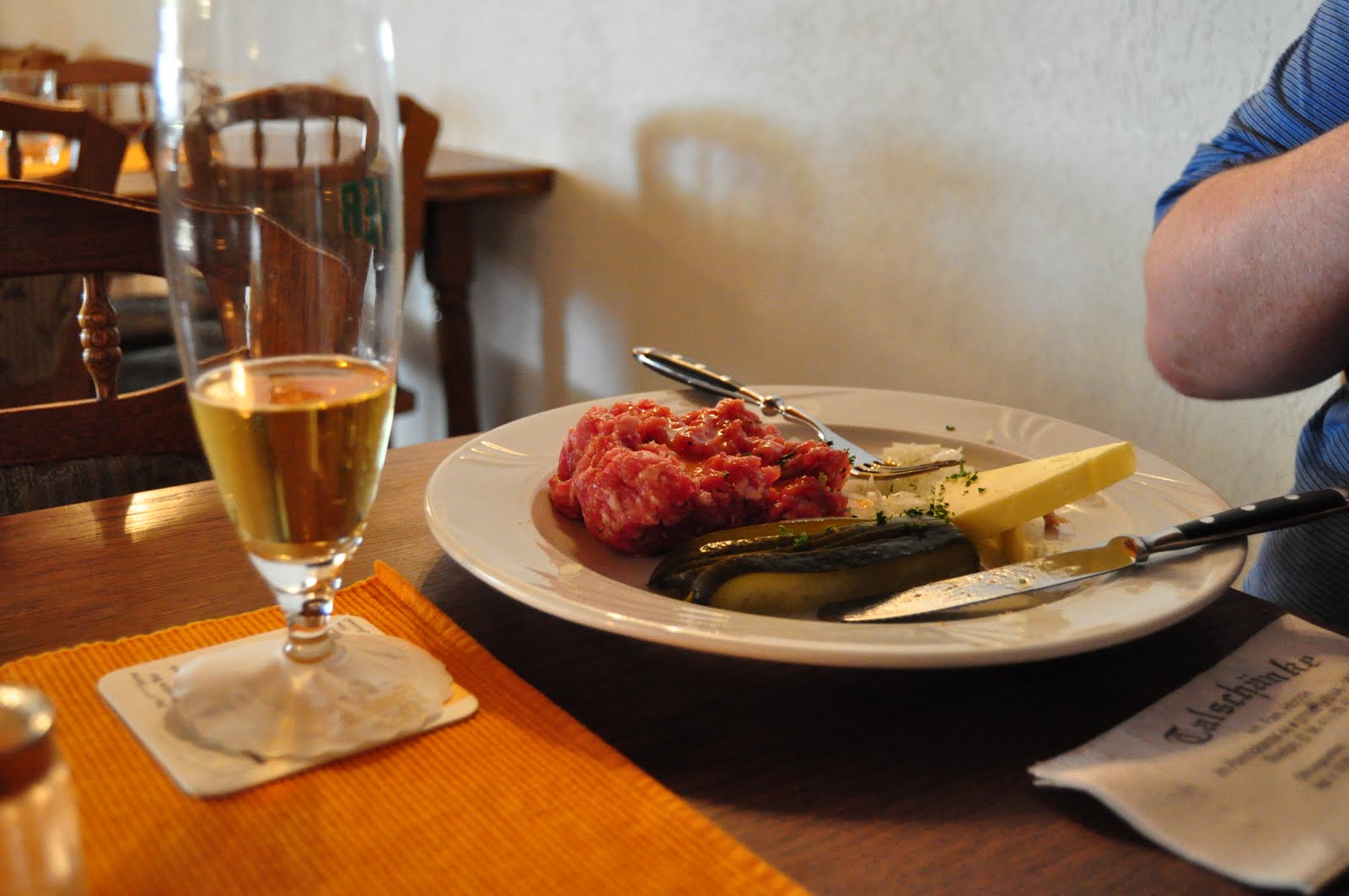
And speaking of delicous? Hackepeter! Take raw pork, add some fresh onion, a raw egg and some spices, toss it on a plate, and voila - deliciousness on a plate. My mother would die knowing we were dining on a plate of raw pork & raw egg, but I am starting to believe that cooking meat ruins it.

A bit of Jever next to some Hackepeter, a pickle, and a giant wedge of butter
It's a regional specialty, and we ran into a variant of the raw pork delicacy in other cities... but first? Dortmund.

Friday, April 15, 2011

A Collaboration to make you say Dankeschön

Those of you who have ever driven into Lawrence KS probably know that it has a sister city:  Eutin, Germany (pronounced OY-tin). Eutin's in the very north of Germany, not too far south of Denmark, and is a popular tourist destinations for the Danes. Like Lawrence, it's a hilly city in the middle of flat land. Unlike Lawrence, it has a castle. We need more castles.

This weekend, Free State celebrates its sisterhood with a collaboration beer made with the brewers of Brauhaus Eutin.
We’ve teamed up with the brewers in our sister city of Eutin, Germany to brew a collaborative beer to celebrate the musical and cultural exchanges coming this summer with Lawrence and Eutin residents. On Sunday evening, April 17th, we’ll host an entourage of Eutin guests at Free State, and celebrate the continued success of this sister city effort.  We’ll tap the first keg of Eutin St. Michaelis "Tafelbier" (unfiltered amber lager) at 7:30. Come welcome our Eutin guests!
The Eutin Brewery's Tafelbier is served at the Brauhaus Eutin under their St Michaelis brand, and is approximately 5.5% ABV. It's light, sweet, and not that hoppy in Germany; we'll see how the collaboration version compares. This is probably one of the more unique and clever collaborations I've seen recently. Unfiltered German amber lager made via a collaborative effort by Germans (who make it for a living) and one of the best breweries in the region? Yes, please.

Again, that's this Sunday (April 17th) at 7:30pm in Free State's brewpub on Mass. See you there!

Tuesday, November 16, 2010

Part 2: Kulmbach


Since we had three full days in Bamberg, we decided to take a day trip to Kulmbach, which is about 45 minutes north of Bamberg. We went primarily for the Beer & Bread museum, which is also adjacent to the Mönchshof brewery & biergarten. The Mönchshof line was originally brewed by the Mönchshof-Bräu brewery until the early 80s, when it was bought by Kulmbacher Brauerei (who also owns the EKU brand).  We get their Schwarzbier here in the states, and I was anxious to try it fresh off the tap to see how it compared to our boat-aged bottled version we get here.

The beer museum was definitely worth visiting. The bread museum wasn’t really that interesting and, as a result, was completely empty save for a couple of unknowing American tourists. We probably spent a good 1-2 hours in the beer museum, though, marveling over all the old brewing and bottling equipment. 


Old bottling system

Cool ship

The museum brews its own beer (and bakes its own bread), using open fermentation tanks. At the end of the tour, you get “Museumbier” and some museum bread to accompany it.
Open fermentation at the museum


Museum bread in solid & liquid states

After our educational lessons on brewing & baking, we settled in to the beer garden for a midday brew. There was a live band playing on one side of the biergarten, entertaining a few dozen Germans there for the afternoon. In typical fest form, they all had interlocked arms and were swaying back & forth while singing along to some traditional drinking songs.

While taking in the sights & sounds, I thoroughly enjoyed my much-anticipated Mönchshof Schwarzbier. This style can be deceptive due to its appearance; it's not rich or creamy, it doesn’t have sharp roastiness, and - as with other German lagers - you won't find fruity esters from the yeast. The version from Mönchshof was lightly roasty, only mildly sweet, and wonderfully dry. It had just enough hop bittering to balance the roast and malt, with a faint hop aroma or flavor (too much would have been unwelcome). Perfect for a beautiful fall day.

The difference between having this beer on tap in Germany vs. from a bottle (or even a mini-keg) in the US was noticeable, but not dramatic. You can find their Schwarzbier in a lot of stores that carry a broad selection of imports.

Or, you can try a similar but more fresh & vibrant version on tap at Gordon Biersch. Put some traditional German drinking songs on your MP3 player, don your headphones, and pretend you're in Northern Bavaria. Eins, zwei, zuffa!

Tuesday, November 2, 2010

Part 1: Bamberg

As I mentioned earlier, Mr Wort Hog and I spent about 10 days in October traveling around Germany and the Czech Republic.We went to cities that have historical significance in beer and were able to try several examples of prominent styles. So, here's the first of several recollections of our trip...

We arrived in Frankfurt on a Thursday morning. It wasn’t long before we were in our rental car and on our way to Bamberg, about 3 hours east of the Frankfurt airport in Northern Bavaria. It was only after booking our trip that we found out Schlenkerla would be releasing their Urbock our first night of arrival. During lunch we learned that tapping would start at 5pm, so we made plans to walk around town until 4:30 or so then head down to the brewery for the tapping.

We ended up arriving around 4pm so we could avoid the crowd rush... As it turns out, all we needed to do was show up some time before 8pm. Before then, the beer garden was relatively empty - entirely different from our experience with brewery special releases in the States. Around 9pm or so, the biergarten was so full, you had to pull your way through the crowd just to move from one place to the next. Bamberg's a university town, and we introduced ourselves to a group of graduate astronomy students who were speaking English... Talking physics and solar flares is quite a feat after about 2 liters of bock.
Biergarten at Schlenkerla
Fresh Schlenkerla urbock is a distant relative of the old stuff we get here. It tasted fresh and smoky without being "meaty"; less like bacon and more like warm campfire. Imagine drinking a lightly sweet bock while hanging out with friends at a bonfire. That's Schlenkerla Urbock.
Fresh Urbock
They tapped keg after keg after keg...
Yeah, he tapped that
October & November mark the release of bock beers throughout Germany. Several months ago, I found a website that listed the dates of dozens of bock releases in the country. I can't find it now, but if you're a Google Master, please send me a link if you find it.

Next up - the other breweries of Bamberg.

Friday, July 30, 2010

Ich liebe Grünauer

A couple of months ago, I received an email from JP's wine bar stating that they were featuring Austrian wines to highlight the opening of nearby Grünauer Austrian restaurant (which replaced City Tavern). I never did make it out for JP's specials, but I did go to Grünauer's website and decided it was worth a visit. Besides, Kansas City is essentially a complete void of continental European food, despite the number of German immigrants to this area; we've been wanting some German food for a while and figured Austrian was close enough.


We drank and dined in the Wunderbar, Grünauer's lounge, and had a fantastic time. Not only was the bar service inviting and personable, the food and drink were spectacular. For my pre-dinner drink, I got "Der Schmutzige" (the dirty one), which is "Black peppercorn and mustard seed infused Monopolowa vodka, Frank's Kraut Juice, beet brine and dill pickle water shaken with vigor and served up with a dill wedge." For someone who loves savory gin drinks, this was delectable. About 80% through, though, I have to admit that my palate was getting pretty tired from all of the goings-on in the beverage. Even still, it was very good; the flavors blended together well, and I appreciated the creativity.


For dinner, we ordered the Schweinebraten and Tafelspitz and enjoyed them both. The Schweinebraten (with dumplings! yum!) was just like I remembered in Germany, and maybe even a bit better. The Tafelspitz (sliced beef with broth & noodles) was surprisingly rich with depth and flavor without being greasy or too thin. We paired our dinner with a handful of Czech, German, and Austrian beers and thoroughly enjoyed our evening there.


After such a great initial visit, we returned this past Thursday night for dinner & drinks, including a comparison of draft versions of Bitburger and Czechvar (the latter of which I am becoming an avid fan) for BJCP "studying". They have several continental lagers on tap (Spaten Bock, Bitburger, Czechvar, Hofbrau, Carlsberg, Warsteiner) as well as a Kölsch and Hefeweizen, and about 7 or so Boulevard drafts. With about a dozen more beers in bottles, there's no lack of malty goodness to be enjoyed. It's inspiring to see dedication of an entire faucet tower to Boulevard, but I'd really encourage you to try some of the European drafts. They're quite different from the bottled versions since they're not light-struck, oxidized, or stale. If you've never had any of the aforementioned brands on draft, you owe it to yourself to have one.

photo from Grünauer's Facebook page
This time, we settled for more typical entrees - Berlinerwurst and Wiener Schnitzel. Both were, again, well-executed and reinforced our affinity for the place. And the service was, of course, friendly, attentive, and timely.

A mention of Grünauer wouldn't be complete without recognition of its huge selection of gin. It's got about 15 (or more?) different gins available for your enjoyment. Really! I check out the gin selection of every bar I go to, and this has to be the largest inventory I've ever seen.

Bottom line - Grünauer has several things going for it and I hope they're here to stay. The food is authentic and delicious, the cocktails are creative and well-executed, the liquor selection is well above par, the service is attentive, and they have a thoughtful beer selection that goes way beyond the typical Euro-lager. I hope you'll pay them a visit and enjoy this place as much as we do. 

Tuesday, May 4, 2010

A Toast to Dad in ALS Awareness Month

May is ALS Awareness month and, while I normally wouldn’t include this sort of thing on my blog, this is a topic that’s close to me and my family. ALS, more commonly known as Lou Gehrig’s disease, is a fatal disease that progressively kills your motor neurons until your body can no longer function. Dad was diagnosed in 1999. He was having a hard time holding things and, after ruling everything else out, doctors determined he had ALS. Most people die within 5 years of diagnosis; dad died in 3.

In 1992, Dad had an opportunity to take a temporary job in Heidelberg, Germany for the Dept of Defense. He accepted the assignment and took the family with him over the summer. After a brief return to the states, he accepted a longer contract in 1993 and the family moved to Heidelberg for a five-year stint. I was in college in the states during that time, but got to spend summers in Heidelberg (plus I took most of a year off college to work & travel over there).

My dad left the US drinking MGD and returned drinking German beer – most typically Pils, Dunkles, or Hefeweizen. His experience there completely changed his perspective on beer, which led to my own understanding that beer was something more than Blue Boar.

He took a few trips to Bamberg, home of Rauchbier; it was one of his favorite cities, and I’ll never forget hearing about his discovery of beer that tasted like ham. He took the family to Berlin and introduced me to Berliner Weiss (mit schuss, of course). He also introduced me to Hefeweizen, which I swore had a shot of banana syrup in it no thanks to that Berlin experience. I drank my fair share of Helles and Pils, typically at fests in various small towns we’d visit. And a lot of Grolsch. (I blame that on the clubs.)

And, finally, he introduced me to the concept of proper glassware. He collected steins, krugs, goblets, weizen glasses, and a bunch of other beer-holding devices. My mom’s been gracious enough to let me have many of the glasses he collected, including small samplers from various small-town breweries and fests. My favorite, though, is the Augustiner Edelstoff willi becher glass. I hope to have this one for a long time.

Though Dad was diagnosed with ALS shortly after the family’s return to Portland, his interest in good beer continued. We hung out at Produce Row, Bridgeport, and Horse Brass. We drank Deschutes, Rogue, Widmer, and other good Oregon brews in a city that would, just a few years later, become a major beer destination for beer enthusiasts everywhere. He would have loved what’s happened with craft beer and I have no doubt he would have continued to introduce me to new aspects of the brewing world.

May 25th would have been my dad’s 61st birthday. During ALS awareness month, in honor of my dad and the beer enthusiasm he developed while in Germany, I propose a toast to those who have sparked or shared your interest in craft beer, glassware, beer-related travel, and all other things beery. Prost!

Doug - Dad and Beer Lover
1949 - 2002

To find out more about ALS or how you can help, visit the ALS Association's website. To volunteer for a charity walk, find an upcoming walk  near you.

Thursday, October 22, 2009

Here's a Cheer for Roggenbier

The Roggenbier made on Brew Day #4 is now kegged and carbonated - and delicious! This has turned out to be a fantastic brew. I used the recipe from Brewing Classic Styles by Zainasheff and Palmer, as well as their advice and guidance from their show on Brewing Network. I won't post the recipe (the book is absolutely fantastic and worth the money, and you can get the recipe for free via the webcast), but will tell you that it was about 45% rye malt, 55% barley malt, noble hops, and used Wyeast 3068. That's a LOT of rye! I started out with an Original Gravity of 1.054 and my Final Gravity was 1.016, making this beer right about 5% ABV.

We opted to use our mash tun for this batch to get higher efficiency and thankfully didn't get a stuck mash (though it was dreadfully slow to drain). The pound of rice hulls, I'm sure, helped dramatically. If you're dealing with any amount of huskless grains like wheat, oats, or rye, you really should use these. They were cheap and likely saved us a lot of distress.

As you can see, the roggenbier is naturally hazy ("naturtrüb") per the style. It's a pretty copper-brown color and smells like a spicy weizenbier. Tastes like one too - imagine some pumpernickel bread crossed with the banana & clove esters of a hefeweizen and you pretty much have roggenbier.

This beer is so interesting to drink; the mouthfeel is like no other beer I've ever had. Mouthfeel is soft and a bit feathery with just enough carbonation to keep it light. Hold it in your mouth a little longer, and it suddenly becomes silky, a lot like wheat wine. This is due to the ß-glucan soluble fiber in the rye; those little ß-glucans are also the primary active ingredient in metamucil, and are what gives oatmeal its cholesterol-reducing ability.

We've already had a lot of this beer. Let's just say I'm drinking to my health...

Sunday, October 18, 2009

Beer of the Week: Berliner Weisse


This week's featured beer is Berliner Weisse. I had my first one in 1995, when Christo & Jean-Claude wrapped the Reichstag building in Berlin. My family was living in Germany at the time, and my dad wanted to see the "urban artwork" so we took a trip up to the unified city. I'll never forget the that impressive oddity of a wrapped building, nor will I forget that tart, light Berliner Weisse with a sweet shot (schuss) of raspberry syrup. I also blame Berliner Weisse for my subsequent (but short-lived) belief that Hefeweizen had banana syrup in it.

Berliner Weisse is a style of unfiltered German wheat beer, but what primarily differentiates it from its other weizen cousins is the presence of lactobacillus bacteria. The bacteria will generate lactic acid during the fermentation, providing acidity and tartness to the final product. The grain bill is typically about 50/50 malted wheat and barley, and the starting gravity is pretty low at around 1.030 (+/- .002). This means that there aren't a lot of sugars in the beer to ferment out and the resulting beer is low in alcohol. You might have tried the 1809 Berliner Weisse at The Westside Local, but its alcohol content is nearly double what the style dictates.

Traditionally, the wort for this beer was never boiled. Some of the mash water would be drained off then boiled separately with the hops, to isomerize the acids from the hops. The water would then be added back to the mash, the wort drained off, the yeast pitched, and fermentation initiated. There was enough lactobacillus in the grain to create the sourness needed in the beer, but results did vary. In my own mini-research on this, it seems a lot of brewers these days perform a boil and add lactobacillus in controlled amounts; other options are to add acidulated grain or create a sour mash. Some home brewers add lactic acid to taste after fermentation.

Berliner Weisse is typically served in a goblet with a shot of green woodruff (herbal) or red raspberry syrup - and a straw. This is to temper the acidity of the beer and was an addition purportedly started by Napoleon who found the beer appealing but too acidic. He dubbed the beer the "Champagne of the North" in 1809.


I picked up a small bottle of this at Royal Liquor last weekend for a little over $3. I didn't realize it at the time, but it was made by the same brewery who created last week's beer, a Gose. And yes, as you can see in my picture, I poured it into the wrong style of glass. While it is a German wheat beer, Berliner Weisse should be served in a stemmed goblet, not a weizen glass. Somehow, I suffered through!

This beer smelled a bit like fresh, unbaked bread dough and its initial taste was citrusy and acidic, a little like lemon zest but not as sour. The mouthfeel was soft from the wheat and light-to-medium carbonation, but the acidity in the beer made it light and dry rather than creamy or heavy. The lactic acid is prominent in the beer, but this is a sour beer that is much more drinkable than, say, a Geuze or Flanders Red. There was just a hint of grassiness or fresh wet hay flavor from the lactobacillus, but not enough to warrant one of my favorite beer descriptions of "horse blanket" (that still makes me chuckle. Yes I am easily amused.)

This is a wonderful style for summer that is very easy to drink; with winter coming, consider this advance research for next year. With the low ABV and thirst-quenching appeal, it qualifies perfectly for a "session beer" designation. At its price point, however, this is definitely a beer to be savored. I hope we see more of these fill the shelves in the future. I am optimistic; Southampton just won a gold medal at the GABF for its Berliner Weisse and I hope that inspires other breweries to try their hand with the style.

For more information, a couple of recipes can be found in Brewing Classic Styles and on Homebrewtalk.com, and more information on the style can be found in Designing Great Beers and on BJCP.com.

Sunday, October 11, 2009

Beer of the Week: Gose


I've wanted to do a "beer of the week" feature for a while now and was planning on waiting until 2010. My impatience wins, however, so I'm starting now. I hope to post these every Sunday or Monday, though that may change. My intent is to write about styles, substyles, notable beers, and other style-related topics, though that may change too; we'll see how it goes.

First up? Gose.

A couple of months ago, I was flipping through Randy Mosher’s Radical Brewing and ran across a style of German beer I’d never heard of before:  Gose (GO-zuh). In it, Mosher explains that this style of beer is made with salt (yes, salt!) and coriander. It is also slightly sour, similar to a Berliner Weisse, and low to moderate in alcohol at around 4% ABV. The sourness initially came from wild, spontaneous fermentation (similar to the sour Belgian beers), but now is managed much more accurately and reliably with the addition of lactic acid bacteria.

My curiosity piqued. Another sour German beer? (see Berliner Weisse) Slightly salty? Citrusy? Count me in! I looked for it everywhere I went, but never found any until I went to Lukas Liquor in Martin City. I was looking for some German beer and there they were – two little bottles tucked away on the bottom shelf. I grabbed both of them, along with a few other beers, and headed home.

Gose is an old style of beer, originating from Gosen (hence the name) as early as the 900s, and popularized in Leipzig. Thanks to the predominant wheat crops in the area, about 50% of the grain bill is malted wheat. Gose production fell to zero during and after WWII due to bombing of some of the breweries and economic difficulty (see: East Germany). Thanks to brewers in Leipzig, German reunification, and the relaxation of brewing limitations in Germany, though, Gose is experiencing a revival. 

The beer itself is interesting and not as strange-tasting as you might think after reading the ingredients. It pours a hazy pinkish-orange color and maintains its turbid appearance long after pouring. The aroma is one of citrus, largely grapefruit, and the initial taste is citrusy as well. The salt only enhances the subtleties of the beer and isn't noticeable, and the finish of the beer is similar to a wit in acidity and light spicy coriander. The tartness of the beer complements the citrus overtones well and makes it quite a refreshing drink.


If you like Belgian Wit, Geuze, Berliner Weisse, tart lambics, or oranges in your American Wheat – I bet you’d like Gose. I bought the beer you see above, produced by Gasthaus & Gosebrauerei Bayerischer Bahnhof. You can find it at Lukas Liquor in Martin City for about $3 per 11.3oz bottle. 

Want to brew one? Mosher has a recipe in his book, or you can try your hand at the recipe on homebrewtalk. There's quite a bit of information in that thread to guide the adventurous homebrewer.

Wednesday, July 22, 2009

Beer... Is there anything it can't do?

Earlier this month, the New York Times published an article about beer-based cocktails. Around the same time, there was at least one lively thread on whether adding other ingredients to packaged craft beer (or vice-versa) was disrespectful to the art-in-a-glass. I'm not sure I agree with that, but I can appreciate the argument.

Mixing beer with other ingredients is nothing new. The Germans have been doing it for ages with the Radler ("Cyclist"), a beer & lemon soda combo perfect for summer. College kids do it (Irish Car Bombs, anyone?), I think everyone's heard of a Snakebite (lager & cider), and I know you have been fervently drinking Micheladas ever since I posted about them.

Speaking of Micheladas, in late June John and I ventured over to Free State (have you seen their new website?) where they offer a Michelada... Free State style. It's not really as much a Michelada as it a margarita with beer instead of triple sec. It's made by filling a glass with ice, adding tequlia and sour mix, then topping it off with their Wheat State Golden. I'd had everything else on their menu on other visits; why not try it? I'm glad I did. It was light, refreshing, and surprisingly easy to drink. Almost too easy. If you like beer, and if you like tequila, I highly recommend checking it out.

After the Free State Michelada experience, my curiosity was set alight and I looked online for other beer cocktails. As it turns out, it seems they're growing in both popularity and acceptance, bordering on (dare I say it) trendy. Epicurious.com lists a "top 5 beer cocktails" article. A Google search for "beer cocktail" provides over 13 million results. I spent much of my lunch hour today looking at recipes and suggestions. I thought the "Skip & Go Naked" (PBR + Gin + Grenadine + Lemon) sounded pretty tasty, but then I stumbled upon a gin, Duvel, and absinthe concoction that I can't wait to try.

Mixing beer with spirits isn't the only option, however. Combining different beers together also lends some new taste experiences. Of course, there's the quintessential mixed beer drink, the black & tan (or the half & half if you prefer lager with your stout instead of ale). But what about more creative combinations? I've seen Young's Double Chocolate Stout + Lindemans Framboise grace a few menus in the past few years, but not much else. When we lived in Portland, the Rogue Public House (just a few blocks from our apartment - those were the days!) had an entire menu of mixed beers, each with its own name. Consider, for example, Dead Guy Ale mixed with Old Crustacean barleywine (a "Dead Crusty Guy"). Or how about Chocolate Stout and Hazelnut Brown ("Snickers")? And lest Kansas City be left out of the beer-mixing trend, we have our very own Thundercloud (Boulevard wheat & stout).

So what do you think? Does mixing beer with spirits wreck or disrespect the beer? Are there any beer combinations you think are particularly good? I don't know about you, but I think these questions are best answered after some thorough research!

Sunday, July 19, 2009

The Westside Local


John and I had lunch at the Westside Local yesterday to check out their food and beer selection. The place is brand new, having opened last Wednesday (7/15).

The owner, Troy McEvers, is a local himself and clearly has an interest in highlighting regional and house-made foodstuff. From the house-made pickles, kraut, and charcuterie to locally-sourced meats, the menu clearly demonstrates a high level of attention to the food and its sources. The executive chef, Rick Martin, clearly has a passion for both beer and food. He spent 17 years at Free State in Lawrence and has spoken about food & beer at the Great American Beer Festival, Savor, and the Craft Brewers Conference (check out part of the keynote address from this year's conference)

We walked into the Local, where we could see all of the 20 or so tables in the dining area, but chose to sat outside in the beer garden. We walked through the small but well-stocked bar area and out to the garden. There are 5 long fest-style tables with benches outside, covered by what will become a large ceiling of grape vines.

We were handed food, beer, and wine menus and the selections for each are thoughtful and varied. The service was quick and attentive, and we ordered the charcuterie and pickles with two beers; John got the 1809 Berliner Weisse and I ordered a bottle of Ayinger Bräu-Weisse. The menu contains beer recommendations for each food item, highlighting chef Martin's expertise. Yes, we did ignore the beers paired with our food orders, but not without acknowledgement.

I can't say I've ever seen Berliner Weisse on any beer menu anywhere in the states, and wish I'd ordered it. John did let me sample it, though. I had it once in Berlin, back in 1995, and it tasted just like I remembered: a lightly fruity weizen flavor (significantly less banana & clove than its Hefeweizen brothers) and a tiny bit tart. Berliner Weisse is, as its name suggests, a style native to the Berlin area in Germany. It's a traditional wheat beer, but with a couple of key differences: it is brewed with a lactobacillus bacteria, added to provide the sourness, and typically contains around 2-3% ABV. Due to the sourness, it's typically served "red" or "green" - with a shot of raspberry or woodruff syrup - and with a straw.

The Westside served both our beers in tulips. If I had to come up with a complaint about the Woodside Local, incorrect glassware would be it. Mine should have been served in a weizen glass and John's in a goblet. Did it matter? No, not really. But with the level of detail and attention given to the food, beer, and pairings, it was a little surprising.

That, however, would be my only complaint. The bread on my Monana chicken sandwich was soft, the chicken moist and tender, and the homemade kraut light and crisp and not overly acidic (just the way it should be). The french fries were just barely on the oily side of perfect - crisp and rich with potato flavor with just a hint of garlic. John's roast beef sandwich was on a crunchy baguette with a flavorful malt (wort?) au jus that wasn't overly salty (a common problem I have with au jus sandwiches).

We'll definitely be back to sample more of the food and drink more of the beer. And so that I can get my own bottle of that light, tart Berliner Weisse.

pictures from the Westside Local's Facebook page

Sunday, February 22, 2009

Upcoming Beer Tastings at Grinders

Grinders hosts a "Taste Beering" with food pairings every 2nd Thursday of each month. The upcoming March 12th beer tasting features several Ommegang beers.

According to their website, here are the menu offerings:

1. Ommegang Hennepin: paired with a floral & citrus shrimp ceviche
2. Duvel: paired with spanikopita
3. Maredsous tripel: paired with a spicy chicken taquito w/ green chile sauce
4. Ommegang Abbey Ale Tripel: paired with bacon wrapped dates stuffed with pecan creamed cheese
5. Ommegang Three Philosophers: paired with a lemon tartlette

(bacon-wrapped dates? HOW HAVE I NOT THOUGHT OF THIS???)

Tickets are $17 prior to the event, $26 at the door.

April's Taste Beering will feature Unibroue (which, I learned on our trip to Quebec last year, is pronounced "OOO-nee-broh"). Details aren't yet posted.

Side Comment - we ordered a basket of 6 chicken wings with "death sauce" and they wouldn't let us order it at first ("we put it on the menu as kind of a joke" they said...). They gave us a little sample taster of the sauce, which was pretty damn hot but tasted quite nice. We were able to order them after some convincing, and they were delicious.

If you've been disappointed at the lack of spicy food in KC, this will definitely renew your faith that spicy food does exist here. And if anyone has some tips on how to get places to believe me when I order food hot, let me know. I've tried everything I can think of, and nearly always get some jalapenos tossed onto the top of my dish. So disappointing. The sauce they use, by the way, is Dave's Insanity Sauce.

And, last but not least, I enjoyed a nice Weihenstephaner Hefeweissbier Dunkel. Banana & spice present, of course, and a bit bready. Very nice and easy to drink.

ShareThis